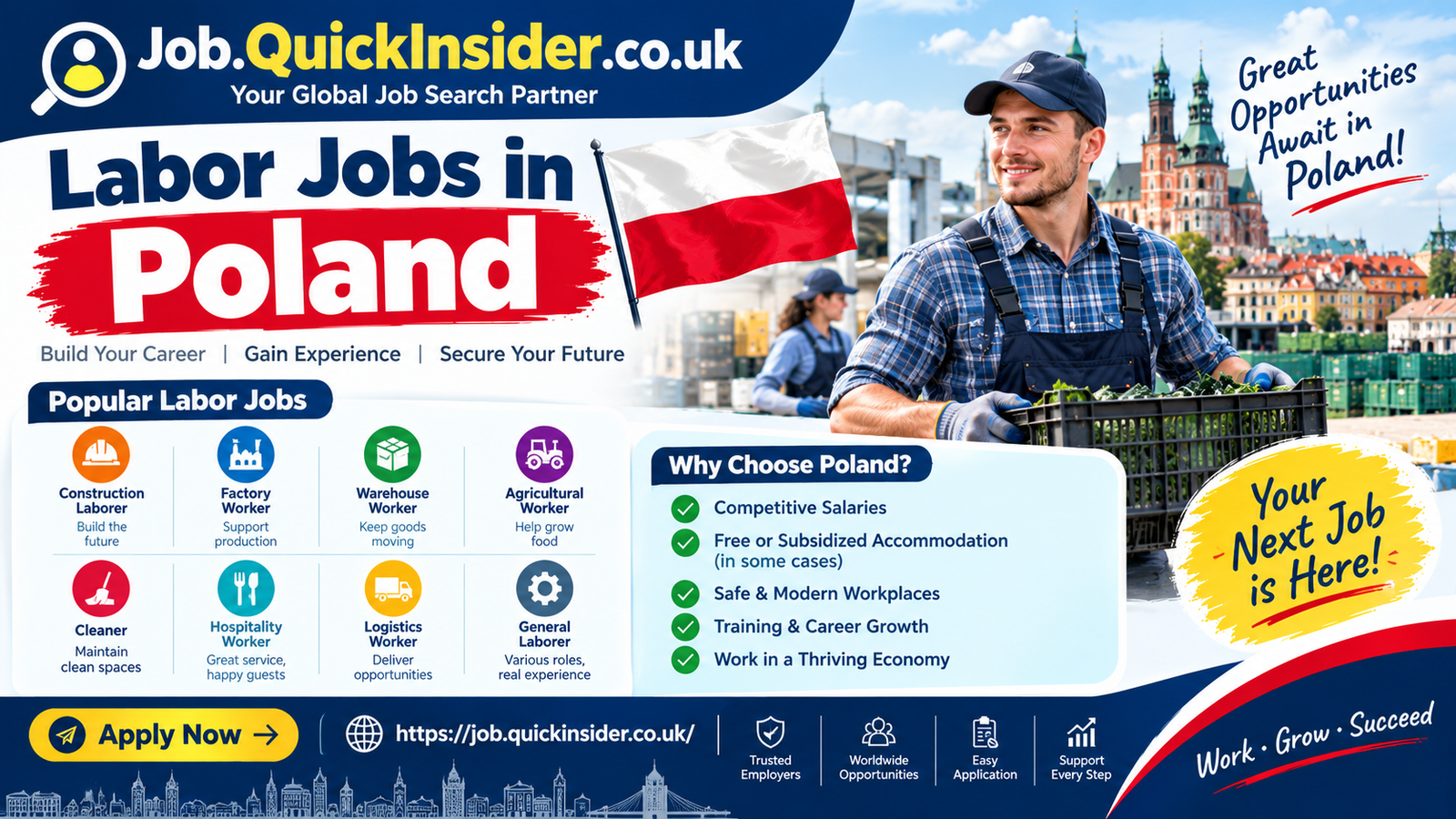
Labor jobs in Poland can provide employment opportunities for people interested in construction, manufacturing, warehouses, agriculture, logistics, cleaning, hospitality, and other practical industries. Poland has a diverse labor market, and employers may recruit both local workers and eligible foreign employees for different types of positions.
For people looking for entry-level employment, labor work can be an accessible way to gain experience, develop practical skills, and build a career. Experienced workers can also find positions offering greater responsibility, specialized duties, or opportunities for career progression.
What Are Labor Jobs in Poland?
Labor jobs generally involve practical, physical, operational, or support duties. The exact work depends on the industry and employer.
Common labor positions include general workers, warehouse workers, production workers, construction laborers, cleaners, agricultural workers, packaging workers, factory assistants, and logistics workers.
Some jobs require little previous experience, while others require technical skills, professional qualifications, or previous industry experience.
Types of Labor Jobs in Poland
General Laborer
General laborers assist with routine tasks at construction sites, factories, warehouses, farms, and other workplaces. Duties can vary from loading and unloading to cleaning, moving materials, and assisting skilled employees.
Warehouse Worker
Warehouse workers handle goods and support logistics operations. Their responsibilities may include receiving deliveries, picking orders, packing products, labeling packages, and organizing stock.
Factory Worker
Factory workers support manufacturing and production processes. They may operate basic machinery, assemble products, inspect items, package goods, and maintain a clean working area.
Construction Laborer
Construction laborers assist skilled tradespeople and construction teams. Tasks may include moving materials, preparing work areas, cleaning sites, loading equipment, and performing basic construction support work.
Packaging Worker
Packaging workers prepare products for shipment or distribution. They may inspect products, place items into containers, label packages, and prepare finished goods.
Agricultural Laborer
Agricultural workers may be employed on farms, orchards, greenhouses, and food-production operations. Seasonal opportunities can include harvesting, planting, sorting, and general farm maintenance.
Cleaner
Cleaning workers can find employment in hotels, offices, factories, warehouses, hospitals, commercial buildings, and other facilities.
Logistics Worker
Logistics laborers support the movement and organization of goods. Depending on the position, they may work with deliveries, inventory, loading, unloading, or distribution operations.
Kitchen and Hospitality Worker
Hotels, restaurants, and catering businesses may employ kitchen assistants, dishwashers, cleaners, housekeeping workers, and other support staff.
Main Duties of Labor Workers
Labor responsibilities depend on the specific position, but common duties can include:
- Loading and unloading materials
- Moving products and equipment
- Packing and labeling goods
- Cleaning work areas
- Supporting production lines
- Sorting products
- Preparing materials
- Assisting skilled workers
- Checking products for visible defects
- Organizing warehouse stock
- Following workplace instructions
- Maintaining safety standards
- Using basic workplace equipment
- Completing assigned tasks on schedule
Workers should always follow the employer’s specific safety procedures and job instructions.
Requirements for Labor Jobs in Poland
Requirements vary considerably between employers.
Entry-level labor positions may not require advanced education or extensive experience. However, employers commonly look for reliable workers who can follow instructions and perform physical tasks safely.
Typical requirements may include:
- Ability to perform physical work
- Reliability and punctuality
- Good teamwork
- Ability to follow instructions
- Basic workplace communication
- Attention to safety
- Willingness to work shifts
- Ability to stand or walk for extended periods
- Previous experience where required
Certain positions may require licenses, certificates, technical training, or previous experience.
Skills That Can Help You Get a Labor Job
Physical Fitness
Many labor positions involve lifting, carrying, standing, walking, or repetitive movements. Good physical condition can help workers perform their responsibilities safely.
Reliability
Employers depend on workers arriving on time and completing assigned duties. Consistent attendance can be an important quality in labor employment.
Teamwork
Many factories, warehouses, construction sites, and farms operate through teams. Workers should be able to communicate and cooperate with colleagues.
Safety Awareness
Understanding workplace safety rules is essential, particularly when working around machinery, vehicles, construction equipment, or heavy materials.
Time Management
Production and logistics operations often have deadlines. Workers need to complete tasks efficiently while maintaining quality and safety.
Willingness to Learn
Workers who learn new equipment, processes, and responsibilities can increase their employment opportunities over time.
Labor Jobs for Freshers in Poland
Freshers may find entry-level opportunities in areas such as warehouses, factories, packaging, cleaning, agriculture, hospitality, and general support work.
Some employers provide workplace training for basic tasks. However, applicants should carefully read the job description to understand whether previous experience is required.
A first labor job can help workers develop skills such as teamwork, workplace discipline, safety awareness, and equipment handling.
Labor Jobs for Experienced Workers
Workers with previous experience may qualify for more specialized or higher-responsibility positions.
Examples include:
- Senior warehouse worker
- Production operator
- Machine operator
- Construction assistant
- Logistics worker
- Forklift operator
- Maintenance assistant
- Team leader
- Production supervisor
Relevant certificates and practical experience can improve opportunities for specialized positions.
Labor Jobs for Foreign Workers
Poland employs workers from different countries, but foreign workers must meet the applicable legal requirements for employment.
Eligibility can depend on nationality, residence status, type of employment, and current Polish immigration and labor regulations.
Workers from outside the European Union should confirm that they have the appropriate authorization before beginning employment.
A legitimate employer should provide clear information about the position, contract, salary, working hours, and required documentation.
Work Permits and Legal Employment
Foreign applicants should never assume that an online job advertisement automatically means they are authorized to work in Poland.
Depending on the worker’s circumstances, a work permit, declaration, residence document, or another form of authorization may be required.
Because immigration rules can change, applicants should verify current requirements through official Polish authorities or qualified immigration professionals before traveling for employment.
Working Hours for Labor Jobs
Working schedules vary according to the industry.
Factories and warehouses may operate multiple shifts, while construction jobs can follow daytime schedules. Hotels, restaurants, and agricultural businesses may require weekend or seasonal work.
Some positions may involve:
- Morning shifts
- Evening shifts
- Night shifts
- Rotating shifts
- Weekend work
- Seasonal schedules
- Overtime
Before accepting an offer, applicants should ask for the expected working schedule and overtime arrangements.
Salary and Benefits
Labor wages in Poland vary according to the industry, location, experience, job responsibilities, working hours, and employment contract.
Some employers may offer additional benefits such as:
- Overtime pay
- Paid holidays
- Employee benefits
- Transportation assistance
- Accommodation in some cases
- Meals or meal allowances in some positions
- Training
- Performance-related incentives
Job seekers should always confirm the actual salary and benefits in writing. Pay advertised online may be presented differently depending on whether it is gross or net pay.
Labor Jobs in Major Polish Cities
Employment opportunities can vary between regions and cities.
Warsaw
As Poland’s largest city and an important business center, Warsaw has employment opportunities in logistics, warehouses, construction, cleaning, hospitality, manufacturing, and services.
Kraków
Kraków has a large service and tourism sector, along with logistics, hospitality, manufacturing, and support employment.
Wrocław
Wrocław is an important industrial and logistics location. Workers may find opportunities in factories, warehouses, distribution centers, and construction.
Poznań
Poznań has strong manufacturing, logistics, retail, and industrial activity, creating opportunities for different types of labor workers.
Gdańsk
Gdańsk and the surrounding region have employment connected with logistics, shipping, manufacturing, construction, hospitality, and services.
Łódź
Łódź has a significant industrial and logistics presence, with opportunities in warehouses, production, manufacturing, and related industries.
Katowice and Silesia
The Silesian region has a large industrial and logistics economy. Opportunities can be found in manufacturing, warehouses, construction, transportation, and industrial support.
Labor Jobs in Warehouses
Warehouse employment is one of the areas where entry-level workers may find opportunities.
Typical duties include:
- Picking orders
- Packing products
- Scanning items
- Sorting goods
- Loading and unloading
- Preparing shipments
- Maintaining inventory areas
Some warehouse positions involve physically demanding work and may require workers to stand or walk for long periods.
Factory and Manufacturing Jobs
Poland has a significant manufacturing sector, and factories employ workers in different production roles.
Production workers may assemble products, operate machinery, inspect goods, package items, or support production lines.
Workers with technical knowledge or machine-operation experience may qualify for more specialized positions.
Construction Labor Jobs
Construction laborers support building and renovation projects.
Typical duties may include:
- Preparing construction areas
- Moving materials
- Mixing or preparing materials
- Assisting skilled tradespeople
- Cleaning work areas
- Loading and unloading equipment
- Following site safety procedures
Construction work can be physically demanding, and appropriate protective equipment should be used.
Agricultural Labor Jobs
Agricultural work can be particularly seasonal. Jobs may be available in farms, greenhouses, orchards, and food-production operations.
Tasks can include harvesting, planting, sorting crops, cleaning facilities, feeding livestock, and general farm maintenance.
Applicants should confirm the exact season, working hours, accommodation arrangements, and payment terms before accepting agricultural employment.
Language Requirements
Language requirements depend on the employer and position.
Some international factories and logistics companies may use English or multilingual workplaces. Other employers may expect workers to understand Polish instructions.
Even basic Polish can be useful for everyday communication, workplace safety, transportation, shopping, and interaction with supervisors and colleagues.
Learning common workplace phrases can therefore be a valuable advantage for foreign workers.
How to Find Labor Jobs in Poland
Job seekers can use several methods to search for employment.
Online Job Platforms
Search using terms such as:
- Laborer jobs in Poland
- General worker jobs in Poland
- Factory worker Poland
- Warehouse worker Poland
- Production worker Poland
- Construction laborer Poland
- Packaging jobs Poland
- Agricultural worker Poland
Using both English and Polish keywords can broaden search results.
Company Career Pages
Large factories, logistics companies, construction firms, hotels, and agricultural businesses may advertise vacancies directly.
Applying directly through a verified company website can help applicants understand the employer and position more clearly.
Recruitment Agencies
Recruitment agencies can connect workers with employers. However, applicants should verify the agency’s identity, reputation, contract terms, and legal status before proceeding.
Local Employment Services
Official employment services and local job centers can also provide information about available vacancies and employment requirements.
How to Apply for Labor Jobs
A professional CV can help you present your experience clearly.
Your application should normally include:
- Full name
- Contact details
- Previous work experience
- Relevant skills
- Education or training
- Certificates or licenses
- Language skills
- Availability
- References when appropriate
Keep your CV clear and focused on practical experience relevant to the position.
CV Tips for Labor Workers
If you have previous experience, explain exactly what you did.
Instead of writing only “worked in a factory,” provide useful details such as:
- Operated basic production equipment
- Packed and labeled finished products
- Assisted with quality checks
- Loaded and organized materials
- Followed workplace safety procedures
Specific responsibilities make it easier for an employer to understand your experience.
Interview Tips for Labor Jobs
Employers may ask about your previous work, availability, physical responsibilities, shift preferences, and ability to follow safety procedures.
Be ready to explain:
- Your previous job experience
- Why you want the position
- Your availability
- Whether you can work shifts
- Your experience with equipment
- Your ability to perform physical work
- Your teamwork skills
- Your understanding of workplace safety
Always answer honestly. Do not claim qualifications or experience that you do not have.
Advantages of Labor Jobs in Poland
Labor employment can offer several potential benefits.
Entry-Level Opportunities
Some positions are designed for workers with limited professional experience.
Practical Experience
Workers can develop valuable workplace and industry-specific skills.
Career Development
Reliable workers may have opportunities to move into specialized or supervisory positions.
Diverse Industries
Employment can be found across manufacturing, logistics, construction, agriculture, hospitality, cleaning, and other sectors.
Skill Development
Workers can gain experience with equipment, production systems, inventory processes, workplace safety, and teamwork.
Challenges of Labor Work
Labor jobs can also be demanding.
Potential challenges include:
- Physical work
- Long periods of standing
- Repetitive tasks
- Shift schedules
- Night or weekend work
- Seasonal changes
- Working outdoors in some positions
- Fast-paced production environments
Applicants should choose jobs that match their physical abilities, experience, and personal circumstances.
Career Growth for Labor Workers
Labor employment does not necessarily have to remain an entry-level career.
A possible progression can be:
General Worker → Experienced Worker → Skilled Operator → Senior Worker → Team Leader → Supervisor
Workers can improve their prospects by learning new skills, obtaining relevant certificates, improving language ability, and taking on additional responsibilities.
How to Avoid Labor Job Scams
Foreign job seekers should be especially careful when dealing with online recruiters.
Warning signs include:
- Guaranteed employment without an interview
- Promises of guaranteed visas
- Requests for large upfront payments
- No written employment contract
- Unclear company information
- Unrealistically high salaries
- Pressure to send money quickly
- Requests for sensitive documents through suspicious channels
Always verify the employer and recruitment company before making payments or traveling.
What to Check Before Accepting a Job
Before signing an employment agreement, check:
- Employer’s legal name
- Job location
- Job duties
- Salary
- Gross or net pay
- Working hours
- Overtime rules
- Contract duration
- Accommodation arrangements
- Transportation
- Holidays
- Probation period
- Work authorization requirements
- Any deductions from wages
A clear written agreement can help prevent misunderstandings.
Tips for Success in a Labor Job
Workers can improve their workplace performance by following a few simple principles:
- Arrive on time.
- Follow safety procedures.
- Listen carefully to supervisors.
- Keep work areas organized.
- Use equipment correctly.
- Communicate problems promptly.
- Work respectfully with colleagues.
- Learn new tasks.
- Maintain good attendance.
- Take workplace safety seriously.
A strong work ethic can help workers build a positive reputation and pursue better opportunities.
Frequently Asked Questions About Labor Jobs in Poland
Can Freshers Apply for Labor Jobs in Poland?
Yes, some entry-level positions accept applicants without extensive previous experience. Requirements depend on the employer and type of job.
Are Labor Jobs Available for Foreign Workers?
Some Polish employers hire eligible foreign workers. However, applicants must meet the applicable employment and immigration requirements.
Do Labor Jobs Require Polish Language Skills?
Not every position has the same language requirements. Some employers may accept workers with limited Polish, while others require sufficient Polish to understand workplace instructions.
Is Accommodation Available?
Some employers or recruitment companies may offer accommodation, while others do not. Always confirm whether housing is provided and whether any costs are deducted from wages.
Are Labor Jobs Physically Demanding?
Many labor positions involve physical activity, although the level depends on the job. Warehouse, construction, agricultural, and manufacturing roles can be particularly demanding.
Can Labor Workers Build a Career?
Yes. Workers can develop practical skills and move toward specialized, operator, team-leader, or supervisory positions depending on their abilities and employer opportunities.
Conclusion
Labor jobs in Poland cover a wide range of industries, including manufacturing, warehouses, construction, agriculture, logistics, cleaning, hospitality, and general support services. These positions can be suitable for freshers seeking entry-level employment as well as experienced workers looking for new opportunities.
Foreign applicants should carefully verify employment eligibility, contracts, salaries, working conditions, and recruitment agencies before accepting an offer. A clear CV, practical skills, reliability, and a willingness to learn can all improve your chances of finding suitable employment.
For current vacancies, job seekers should search verified employers and reputable employment platforms, compare job descriptions carefully, and make sure all employment and work authorization requirements are properly understood before starting work.

One Comment on “Labor Jobs in Poland”